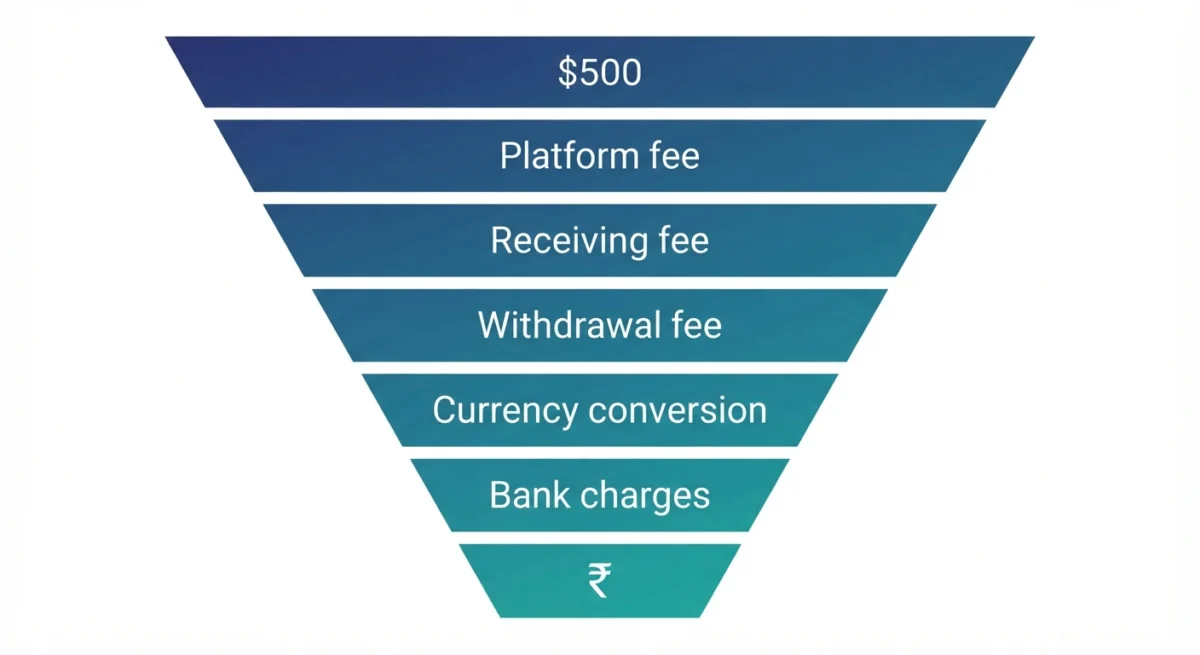
Your Upwork dashboard says $500. Your bank app, a few days later, says something noticeably smaller. Between those two numbers sit four or five separate charges — and most of them are never shown to you as a line item. This is a Payoneer vs Wise comparison for Pakistan that starts with that gap rather than a feature list.
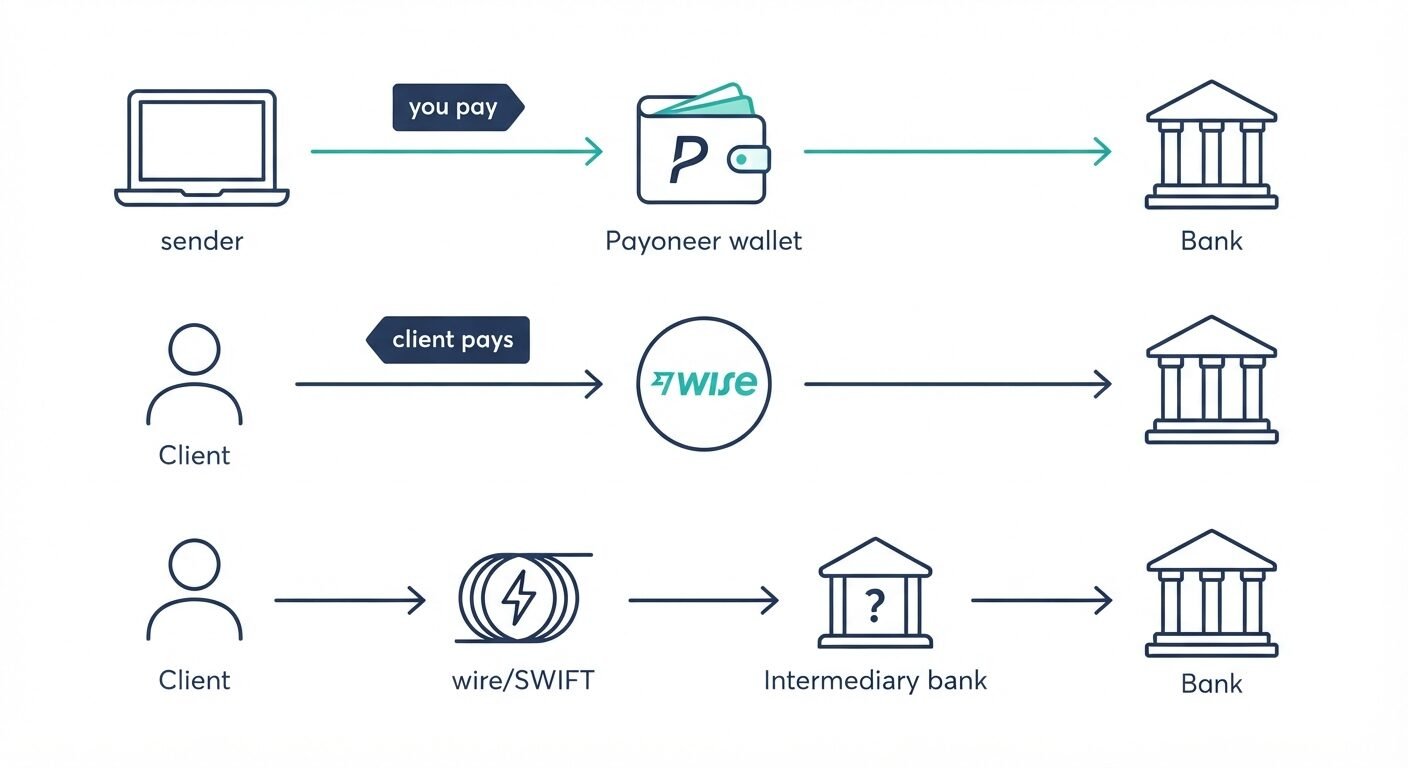
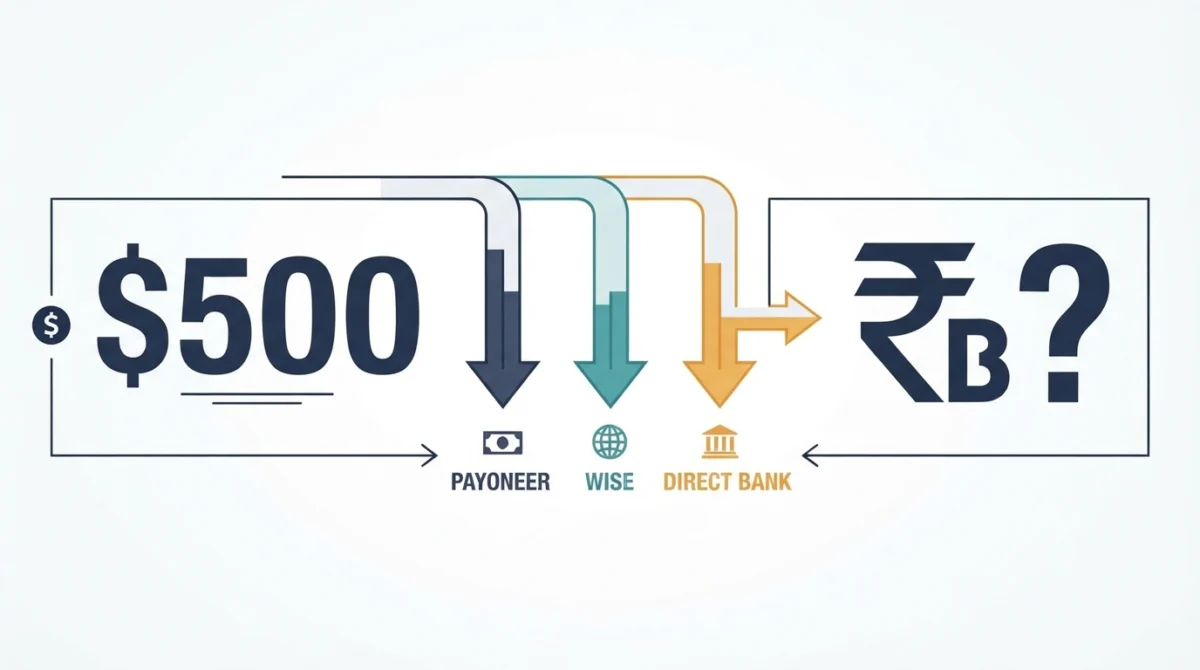
This guide walks a single $500 payment through three routes to a Pakistani bank account: Payoneer, Wise, and a direct bank (SWIFT) transfer. Every fee is labelled as what it actually is — a fixed fee, a percentage, an exchange-rate difference, or a tax — because these four behave very differently and lumping them together is how people end up confused about where their money went.
If you have been trying to compare Payoneer vs Wise Pakistan fees, the honest starting point is that the two are not the same kind of product — and that difference matters more than any percentage. One thing upfront: this article will not give you a single exact rupee figure. Anyone who does is guessing, because the USD/PKR rate moves daily and some bank charges are not published anywhere. What you will get instead is the exact structure of every cost, so you can plug in today's rate and your own bank and get a real answer.
How Much of a $500 Freelance Payment Actually Reaches You?
The honest answer is a range, not a number, and it differs on Payoneer vs Wise for reasons that have nothing to do with percentages. For a $500 payment already sitting in your Payoneer balance, withdrawing to a PKR bank account costs up to 2% in Payoneer's cross-currency withdrawal fee, plus whatever your own bank deducts, plus withholding tax at 0.25% or 1% depending on your registration status.
But that $500 is rarely the amount your client paid. If the payment came through Upwork or Fiverr, the platform already took its cut before Payoneer ever saw it. So there are really two questions, and mixing them up is the most common mistake:
- Client paid → platform cut: Fiverr charges sellers a flat 20%. Upwork moved from its old tiered structure to a variable per-contract fee reported at 0–15% in May 2025, with most freelancers saying they land near 10% on the bulk of their contracts. Upwork shows the exact rate before you submit a proposal, so treat that screen as the authority rather than any published summary.
- Platform paid you → money in your PKR account: this is what the rest of this article covers.
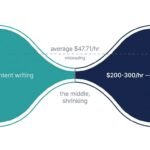
If you want the first half of that picture — why platform fees rose while demand shifted — read what the 2026 data shows about where freelance money actually moved. This guide picks up from the moment the money is yours.
Where Do the Costs Actually Come From?
There are six possible layers. Not all six apply to every route — which is exactly why the three routes cost different amounts.
| Layer | Type of cost | Who charges it |
|---|---|---|
| Platform fee | Percentage | Upwork / Fiverr |
| Payment receiving fee | Percentage or fixed | Payoneer / Wise / sender's bank |
| Withdrawal fee | Percentage or fixed | Payoneer |
| Currency conversion | Exchange-rate difference (hidden) | Payoneer / Wise / your bank |
| Bank charges | Fixed, varies by bank | Your Pakistani bank, intermediary banks |
| Withholding tax | Percentage of gross | Deducted by your bank for FBR |
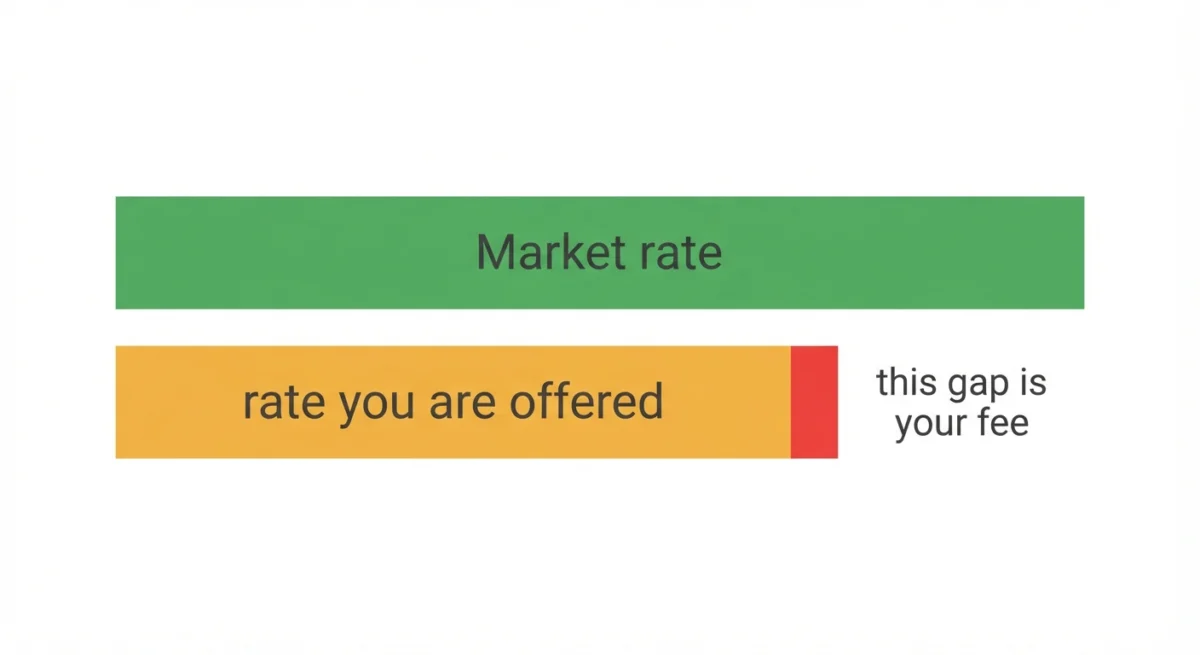
The fourth layer — currency conversion — is the one that catches most people, because it is not deducted as a fee. It is built into the exchange rate you are given. If the real market rate is X and you are paid at X minus 2%, you have paid a 2% fee that appears nowhere on your statement.
Withdrawing Freelance Payments to Pakistan With Payoneer
Payoneer Fees
How the money enters your Payoneer account decides your first cost:
- From a supported marketplace (Upwork, Fiverr, Amazon): generally free on Payoneer's side, since the platform has its own arrangement.
- Client pays your Payoneer request by card: up to 3.99%.
- Client pays by US bank debit (ACH): around 1%.
- Another Payoneer user sends you money: free.
Payoneer also charges an annual account fee, commonly reported at $29.95 and waived once you receive around $2,000 in a 12-month period. Most working freelancers clear that easily, but if you have a quiet year, check your own dashboard rather than relying on the figure quoted here or anywhere else — the receiving fees above are also widely reported rather than officially fixed for every country.
Payoneer Exchange Rate / Currency Conversion
Payoneer does not use the mid-market rate. Per Payoneer's own published explanation of how it calculates withdrawal fees: when you withdraw to a local bank account in a different currency, the fee is up to 2%. USD in your Payoneer balance going out to a PKR account in Pakistan is exactly this case.
Note the words “up to.” It is a ceiling, not a fixed rate. Check the rate Payoneer quotes you on the withdrawal screen against the live mid-market rate on Google or XE before confirming — the gap between them is your fee.
Payoneer Withdrawal to Pakistani Bank
Two important distinctions that a lot of Pakistani freelancers get wrong:
- PKR account (cross-currency): up to 2%, as above. This is what most Pakistani freelancers do.
- USD/EUR/GBP account: a different and higher fee structure. Payoneer raised the rate on withdrawals to non-local-currency accounts for Pakistani users in 2025, and it was widely reported at the time as a 3% flat fee. If you hold a foreign-currency account in Pakistan, confirm your exact rate inside your own Payoneer dashboard before withdrawing — do not assume the 2% figure applies.
Payoneer also states plainly that your bank may deduct processing, landing, or intermediary fees from the amount withdrawn, and that these are not Payoneer charges. There is no universal figure for this — it depends on your bank, and some Pakistani banks deduct nothing on a local-currency credit while others do.
$500 Example — Payoneer
| Step | Cost type | Amount |
|---|---|---|
| $500 in Payoneer balance (marketplace payout) | — | $500.00 |
| Withdrawal to PKR bank (cross-currency) | Up to 2%, built into rate | up to −$10.00 |
| Amount converted to PKR | — | $490.00 or slightly more |
| Bank processing / landing fee | Fixed, varies by bank | Varies — check your bank |
| Withholding tax (Section 154A) | 0.25% or 1% of gross | See tax section below |
To convert to rupees: PKR received ≈ $490 × (the rate Payoneer quotes you). At an example rate of PKR 280 per USD, that is roughly PKR 137,200 — before your bank's charges and tax. Use the live rate on the day you withdraw, not this example.
Receiving Freelance Payments in Pakistan With Wise
This is where almost every Payoneer vs Wise article for Pakistan goes wrong, so read this section carefully before you tell a client to pay you on Wise.
Wise is not a wallet you withdraw from in Pakistan. It is a way for your client abroad to send money into your Pakistani bank account. Those are different things, and the difference decides whether Wise is useful to you at all.
As of 2026, Pakistani residents cannot hold a PKR balance inside Wise, and the Wise debit card is not available for Pakistani addresses, because card eligibility is set by country of residence. Wise's availability in Pakistan also remains subject to State Bank of Pakistan foreign exchange rules and to Wise's own operational decisions, so it can change.
So when a client says “I can pay by Wise,” the workable answer is: yes — send it to my Pakistani bank account in PKR, here is my IBAN.
Wise Fees
The structural difference that matters: on this route, the fee is charged to the sender, not deducted from you. Your client sees the fee and the exchange rate on screen before confirming, and what lands in your account is the PKR figure Wise quoted them.
The exact fee depends on the source currency, the payment method the client uses (bank transfer is cheaper than card), and the amount. Wise publishes a discount for transfers above 25,000 USD or equivalent. This guide deliberately does not quote a single percentage here — Wise's pricing varies by route and is shown live in its own calculator, which is the only figure worth trusting.
Wise Exchange Rate
Wise states that it converts at the mid-market rate and charges its fee separately rather than folding it into the rate. If that holds on your route, it means the conversion cost is visible rather than buried — which is the clearest structural difference from Payoneer and from a bank wire. Verify it the same way you would anywhere else: compare the rate Wise quotes your client against the live mid-market rate at that moment.
Transfer to Pakistani Bank
The recipient receives PKR directly from Wise's local bank account in Pakistan, which is why it arrives as a local credit rather than a foreign wire. One consequence worth planning for: how the transaction is coded matters for your tax position, and a local credit is not automatically tagged as an IT services export. See the tax section below.
Also: Wise's compliance check will reject a name mismatch. If your CNIC reads “Muhammad Usman Khan,” your client must enter exactly that — not “Usman Khan.”
$500 Example — Payoneer vs Wise Side by Side
| Step | Cost type | Who pays it |
|---|---|---|
| Client sends $500 via Wise | — | — |
| Wise transfer fee | Percentage + fixed, varies by route | The client (shown before sending) |
| Currency conversion | Mid-market rate, no added spread | No hidden cost |
| PKR credited to your account | — | You receive the quoted figure |
| Withholding tax (Section 154A) | 0.25% or 1% of gross | You — if correctly coded |
Direct Bank (SWIFT) Transfer to a Pakistani Account
This is the old-fashioned route: your client sends a SWIFT wire from their bank to yours. It is also, for tax purposes, often the cleanest — and for cost transparency, usually the worst.
Possible Charges
- Sender's bank wire fee — charged to your client, varies widely by bank and country
- Intermediary / correspondent bank fees — deducted mid-route, before the money reaches Pakistan. These are the genuinely unpredictable ones: they are not published in a single universal schedule and neither you nor your client sees them in advance.
- Your bank's inward remittance handling — varies by bank; check your own bank's published schedule of charges
Your Bank's Exchange Rate
Your bank converts the incoming USD at its own buying rate, which is not the interbank rate and is not the same at every bank. This spread is the largest cost on this route and the hardest to see, because banks do not publish the margin as a percentage. The only way to measure it: note the rate applied on your credit advice and compare it to the interbank rate for that date.
$500 Example — Direct Bank
| Step | Cost type | Amount |
|---|---|---|
| Client sends $500 by wire | — | $500.00 |
| Sender's wire fee | Fixed | Varies — paid by client |
| Intermediary bank deductions | Fixed, unpredictable | Not disclosed in advance |
| Conversion at bank's buying rate | Exchange-rate spread | Not published — compare on credit advice |
| Inward remittance handling | Fixed, varies by bank | See your bank's schedule of charges |
| Withholding tax (Section 154A) | 0.25% or 1% of gross | Deducted by your bank |
Payoneer vs Wise vs Direct Bank: Pakistan Fees on $500 Compared
| Payoneer | Wise | Direct bank | |
|---|---|---|---|
| Who pays the main fee | You | Your client | Split — client and you |
| Conversion cost | Up to 2%, hidden in rate | Mid-market, fee shown separately | Bank's spread, not published |
| Cost predictability | Good | Very good (client sees it live) | Poor |
| You can hold a balance | Yes, multi-currency | Not in PKR for PK residents | No |
| Debit card in Pakistan | Yes, subject to eligibility | No | Your own bank's card |
| Works with Upwork / Fiverr payouts | Yes, built in | No — client-to-bank only | Limited |
| Export coding for tax | Depends on how bank tags it | Needs attention — arrives as local credit | Usually cleanest |
| $500 rough cost to you | Up to ~$10 + bank charges | Near zero on your side | Unpredictable — often the highest |
Which Costs Freelancers Usually Miss?
- The exchange-rate spread. It is not a fee on your statement, so it feels free. It is usually the largest single cost.
- Withdrawing in small amounts. Fixed fees hurt proportionally more on a $80 withdrawal than a $800 one. Batching helps.
- Intermediary bank deductions on wires. Nobody warns you, and the money is simply smaller when it arrives.
- The $29.95 Payoneer annual fee if you have a slow year and receive under $2,000.
- Losing export status. This is the expensive one, and it is not a fee at all — see below.
What About Taxes in Pakistan?
Under Section 154A of the Income Tax Ordinance 2001, IT and IT-enabled services (ITeS) export income received through approved Pakistani banking channels is taxed at a reduced final rate — meaning no further tax is owed on that income regardless of your slab.
| Status | Rate on gross export receipts |
|---|---|
| Filer, PSEB-registered | 0.25% |
| Filer, not PSEB-registered | 1% |
| Income that does not qualify as IT export | Normal business slab rates |
The Finance Act 2026 extended the 0.25% concessional rate through 30 June 2029, having previously been due to lapse. On $500 the difference between 0.25% and 1% is small change — but on an annual income of Rs 5,000,000 the gap is roughly Rs 37,500, and it scales from there.
Three conditions decide whether you get these rates at all:
- The 80% rule. At least 80% of your foreign income must be received through approved Pakistani banking channels. Income kept in a foreign account, or converted through crypto without being routed back through a Pakistani bank, does not qualify. Informal transfer channels do not qualify either, and using them carries its own legal exposure under Pakistani foreign exchange law — this is not a shortcut worth considering.
- Correct purpose coding. The remittance must be tagged as an export of services, not as a gift or personal transfer. Reports in 2026 point to purpose code 9186 for IT services exports, though banks have been inconsistent — confirm the code with your own bank's remittance desk.
- A PRC (Proceeds Realisation Certificate). This is the document your bank issues confirming that a specific inward remittance arrived from abroad and was classified as a services export. Without it, the money in your account is just money from overseas, and neither FBR nor PSEB can treat it as export income.
A 2026 change worth knowing: the State Bank of Pakistan raised the Form “R” and Inward Remittance Voucher threshold from above USD 10,000 to above USD 25,000 through EPD Circular Letter No. 07 of 2026, issued 6 April 2026. Freelancers also now give a one-time declaration of the services they sell abroad when opening an account, instead of per-transaction paperwork, after which the bank tags the account with the relevant purpose code. Much of the press reported this as freelancers being exempted from declaring export proceeds — that reading is wrong. It is a bank reporting change. Your FBR obligations and your PRC requirements are exactly where they were.
Note also that the withholding rate applies to gross receipts, not profit — before platform fees, bank charges, or expenses. This guide does not calculate a rupee tax figure for the $500 example, because it depends on your registration status and the rate on the day the money landed. Your bank deducts it automatically.
How to Reduce Freelance Payment Costs
- Compare the quoted rate to the live mid-market rate every single time, before you confirm a withdrawal. This one habit reveals the cost everyone else misses.
- Batch withdrawals. Fewer, larger withdrawals dilute fixed fees.
- Ask the client which method costs them least. On the Wise route the fee is theirs, so a client paying by bank transfer rather than card often makes you both better off.
- Get PSEB registration sorted if your annual income makes the 0.75% difference worth the paperwork.
- Check your PRC is being issued correctly, with the right purpose code, from the start — not in September when you are filing.
- Keep a simple log of every payment: date, USD amount, rate applied, PKR credited, fees deducted. Three months of this and you will know exactly which route is cheapest for your bank.
Payoneer vs Wise vs Bank: Which Should You Consider?
On Payoneer vs Wise there is no universally best option, and anyone telling you otherwise is usually earning an affiliate commission. What there is: a set of circumstances that make each one sensible.
Payoneer tends to suit freelancers working mainly through Upwork or Fiverr, where it is already integrated; those who want to hold a USD balance rather than convert immediately; and anyone who values a predictable, capped cost over the lowest possible cost.
Wise tends to suit freelancers with direct clients abroad who are willing to send payments themselves, especially where the mid-market rate matters on larger amounts — but only if you understand it is a receiving route, not an account you withdraw from, and you have sorted out how your bank codes the incoming credit.
A direct bank wire tends to suit larger, less frequent payments from corporate clients who insist on it, and situations where clean export documentation matters more than squeezing the last percent — accepting that the total cost is the least visible of the three.
The factors that should actually decide it: payment size, how often you withdraw, where your client is, which bank you use, whether you need a card, and whether your income level makes the tax paperwork worth optimising.
FAQs
How much does Payoneer charge to withdraw $500 in Pakistan?
Withdrawing from a USD balance to a PKR bank account is a cross-currency withdrawal, which Payoneer prices at up to 2% — up to about $10 on $500, built into the exchange rate rather than shown as a fee. Your bank may deduct additional processing charges.
Can Pakistani freelancers use Wise to receive payments?
Your client abroad can send money via Wise directly to your Pakistani bank account in PKR. But as of 2026 Pakistani residents cannot hold a PKR balance in Wise and the Wise debit card is unavailable for Pakistani addresses, so it is a receiving route rather than a full account.
Payoneer vs Wise: which is cheaper for Pakistan?
Payoneer vs Wise is not a like-for-like comparison. On Payoneer the cost falls on you as a withdrawal fee; on Wise it falls on your client as a send fee, with no conversion spread added. For a direct client willing to use Wise, your own cost is usually lower — but Payoneer is the practical option for marketplace payouts.
What tax do freelancers pay in Pakistan on foreign income?
Qualifying IT and ITeS export receipts are taxed under Section 154A at 0.25% for PSEB-registered filers or 1% for filers without PSEB registration, as a final tax deducted by your bank. The 0.25% rate was extended to 30 June 2029 by the Finance Act 2026.
Do I need a PRC for every freelance payment?
You need PRCs to evidence your export income to FBR and PSEB. The April 2026 Form “R” threshold change reduced per-transaction bank paperwork below USD 25,000, but it did not remove PRC requirements. Ask your bank how it issues PRCs before you rely on the route.
Why is the amount in my bank less than what the platform showed?
Usually four things stacked: the platform's commission, the payment provider's receiving or withdrawal fee, the exchange-rate spread on conversion to PKR, and the withholding tax your bank deducts. Only the first and last are normally visible as line items.
Disclaimer: All calculations in this guide are illustrative examples, not quotes. Fees, exchange rates, bank charges and tax rates change — sometimes without notice. Verify current charges with Payoneer, Wise, and your own bank before making a transaction, and confirm your tax position at fbr.gov.pk or with a registered tax consultant. This article is information, not financial or tax advice.