Short answer: no, freelancing is not dead in 2026 — but the bottom of the market has fallen out, and the middle is disappearing fast. Platform downloads are down, fees are up, and commodity work now competes directly with a $20 monthly AI subscription. At the same time, the top end is paying more than it ever has. The question is no longer whether to freelance. It is which half of a splitting market you are standing on.
If your orders dried up this year and every article you read says “AI skills are booming,” this one is different. So: is freelancing dead, or has it simply moved somewhere you are not standing? This guide looks at what actually broke first, because that is the part nobody explains properly — and then at a counter-trend that most 2026 roundups have missed entirely.
What actually broke
The honest way to test whether freelancing is dead is not to read predictions, but to look at what people are actually doing. And the clearest signal is people quietly leaving the platforms.
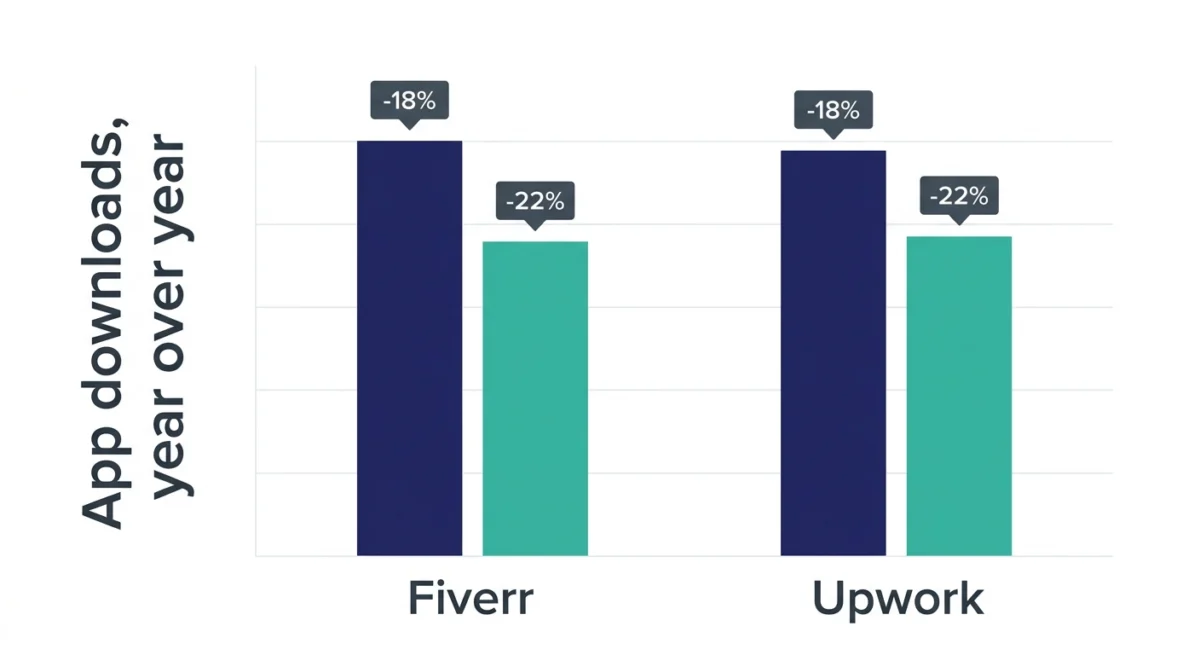
According to Sensor Tower data reported by Self Employed, Fiverr app downloads fell roughly 18% year over year in the first half of 2024, and Upwork downloads dropped about 22% in the same period. That decline has continued into 2026, and the reason is not mysterious: clients who used to post a job for a blog article, a product description, or a simple logo are now opening ChatGPT or an image generator and doing it themselves in ninety seconds.
The financial picture matches. Upwork’s share price has been reported down around 56% across 2026, while platform fees moved in the opposite direction. Upwork replaced its old tiered commission (20% on the first $500, then 10%, then 5%) with a variable per-contract fee of 0–15% in May 2025; most freelancers report landing around 10% on the bulk of their contracts. Fiverr still takes a flat 20% plus payment processing on top.
So the squeeze is coming from three directions at once: fewer buyers for routine work, more competition for what is left, and a larger cut taken off whatever you do win.
The middle is hollowing out
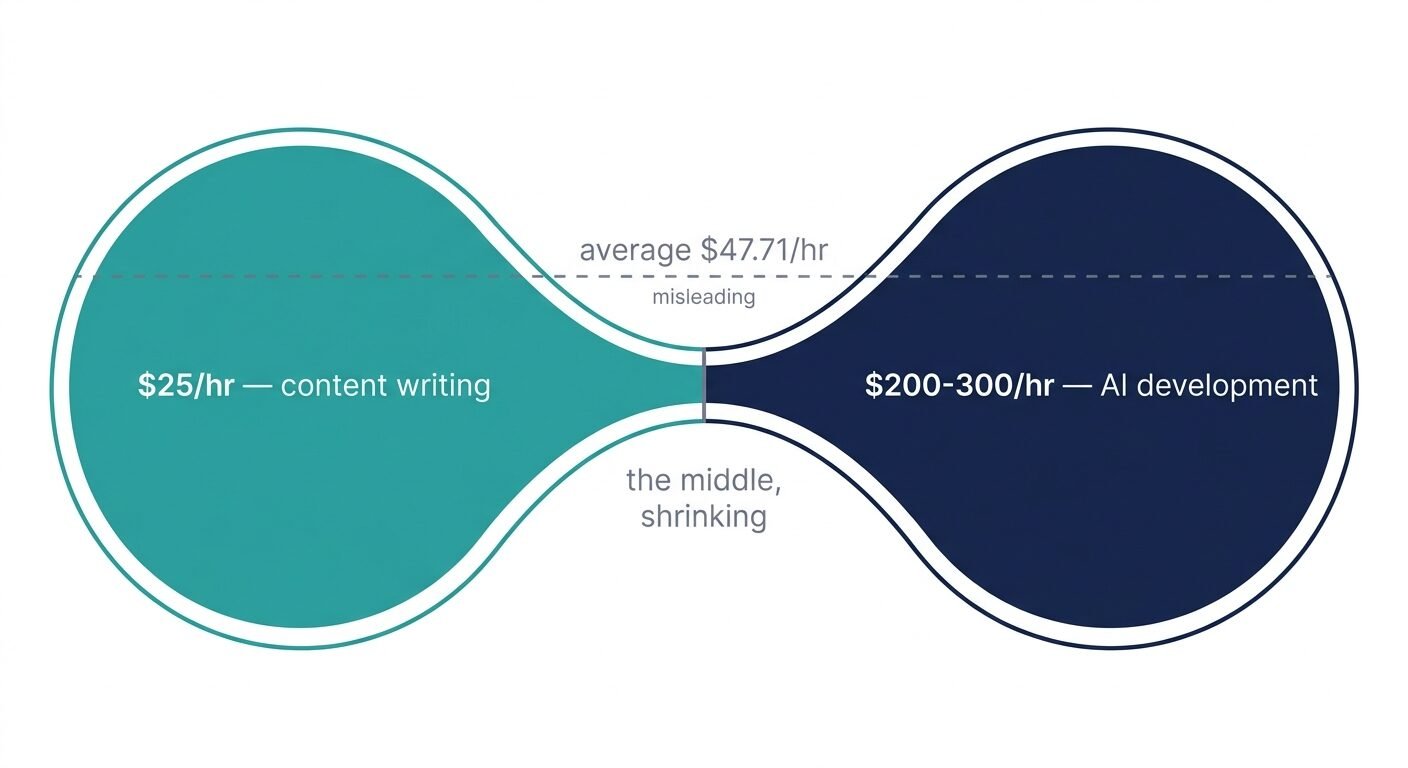
Here is the statistic that gets quoted constantly and understood almost never. Upwork’s 2026 data puts the average US freelancer at $47.71 per hour. That number is close to useless, because it is an average sitting on top of a widening canyon.
On the same platforms, content writers are reported to average around $25 per hour, while senior AI developers bill somewhere in the $200–$300 range. Treat both as indicative rather than fixed — rate surveys vary widely by source and none is an official figure. Generative AI and LLM development work, according to figures drawn from Upwork’s 2026 In-Demand Skills report, typically sits in the $80–$150 per hour band.
And both ends are growing. The number of freelancers earning six figures annually rose from about 3 million to 5.6 million over five years. Meanwhile the commodity end is being compressed harder than at any point in the industry’s history. The people in real trouble are not at the bottom or the top — they are the competent generalists in the middle who built a business on being reliable, fast, and reasonably priced. That exact combination is what AI now offers for a subscription fee.
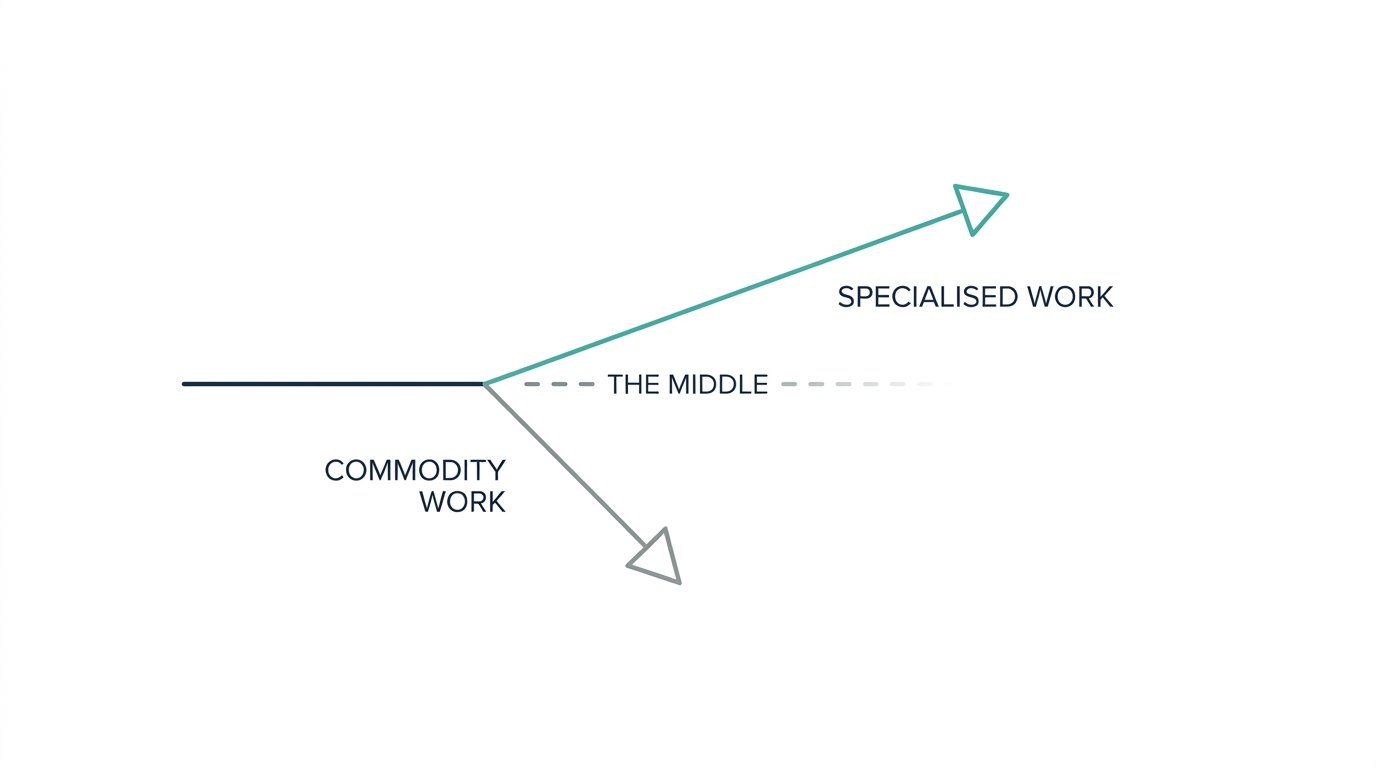
Demand has not vanished, it has relocated. Upwork’s 2026 In-Demand Skills report found freelance hiring explicitly tied to AI grew 109% year over year — more than four times the 23% growth rate for other in-demand skills. Fiverr reported on its Q1 2026 earnings call that AI development and consulting orders were up 118% year over year.
The counter-trend almost nobody is writing about
Every “top freelance skills” list will tell you to learn AI. Fewer will tell you about the backlash forming on the other side, which may matter more if you are a writer, designer, illustrator, or video editor.
The scale of the flood is now measurable. Graphite sampled 55,400 pages from Common Crawl and averaged the verdicts of three detectors: in the first quarter of 2026, roughly 49.9% of new articles published to the web were primarily AI-generated. That figure has hovered near half for five consecutive quarters. Merriam-Webster named “slop” its 2025 word of the year.
Audiences noticed. iHeartMedia’s internal research found that 90% of its listeners — including people who actively use AI tools themselves — want the media they consume to be made by humans. Deloitte’s Connected Consumer survey found close to 70% of respondents worried that AI-generated content would be used to deceive them. Apple TV put an explicit line in the credits of Pluribus stating the show was made by humans. CNN Business went as far as predicting that 2026 would be the year of “100% human” marketing.
What this looks like in practice for freelancers: positioning yourself explicitly as a human practitioner — with specific opinions, a recognisable voice, and documented experience — is starting to command higher rates than positioning around volume or versatility. The old pitch was “I can produce a lot of good work efficiently.” AI owns that pitch now. The pitch that is working is closer to “I bring a point of view you cannot get from a model, and your audience can tell the difference.”
One honest caveat, because you will not get this from most articles: this trend is an early signal, not a proven revenue line. The CNN piece is a prediction. The iHeartMedia and Deloitte numbers measure stated preference, and stated preference and purchasing behaviour are not the same thing. Do not rebuild your entire business around it. Treat it as a reason to stop apologising for being slower and more expensive than a machine — not as a guarantee that clients will pay for it.
Three repositioning moves that are actually working
1. Move the relationship off the platform
Platform dependency is now widely treated as a business risk rather than a convenience. Developers are building visible track records on GitHub and in open source, designers are publishing case studies rather than portfolio thumbnails, and writers are building on Substack or LinkedIn. The common thread is owning an audience and converting it into direct clients, who are reported to pay 30–50% more, largely because no platform takes a cut in the middle.
The honest cost: a reliable direct pipeline takes six to twelve months to build. Start it while platform income is still coming in, not after it stops.
2. Be specific about your AI workflow
The freelancers pulling ahead can name exactly which AI tools they use, for which tasks, and what they still do by hand. That specificity is the differentiator — not whether you use AI at all.
“I use AI” reads as a warning to a client in 2026. “I use it to generate first-pass variations, then rewrite the structure and every claim myself, and I fact-check all sourced numbers manually” reads as competence. Same tools, opposite impression. Write it into your proposals.
3. Sell judgement, not output
Output is priced by the word, the hour, and the deliverable — all three of which AI has made cheap. Judgement is priced by the outcome. A useful test on any gig you currently offer: if a client could describe the task well enough in a prompt to get 80% of your deliverable, that gig is on the wrong side of the split. Move up to the part of the work that requires deciding what should be made and why, not just making it.
What this means if you freelance from Pakistan
The split described above lands harder here than the global numbers suggest, for a reason that has nothing to do with skill.
Pakistan is home to an estimated 2.37 million full-time and part-time freelancers, according to the Asian Development Bank. PSEB puts freelancers at more than $1.1 billion of a record $4.6 billion in IT and IT-enabled services exports for FY2025-26. That is a large workforce — but much of it sits in exactly the segment being compressed: writing, basic design, data entry, virtual assistance, and simple development work priced to compete on rate.
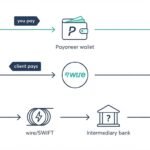
There is also a cost layer global articles never mention. A Pakistani freelancer does not keep the headline rate. The platform commission comes off first, then a payment provider fee, then a currency conversion spread on the way to a PKR account, then withholding tax. On a squeezed $15-an-hour gig those layers matter far more than on a $150 one. If you have not worked out what each costs you, that is worth doing before deciding your rates are the problem — here is every fee traced through a single $500 payment.
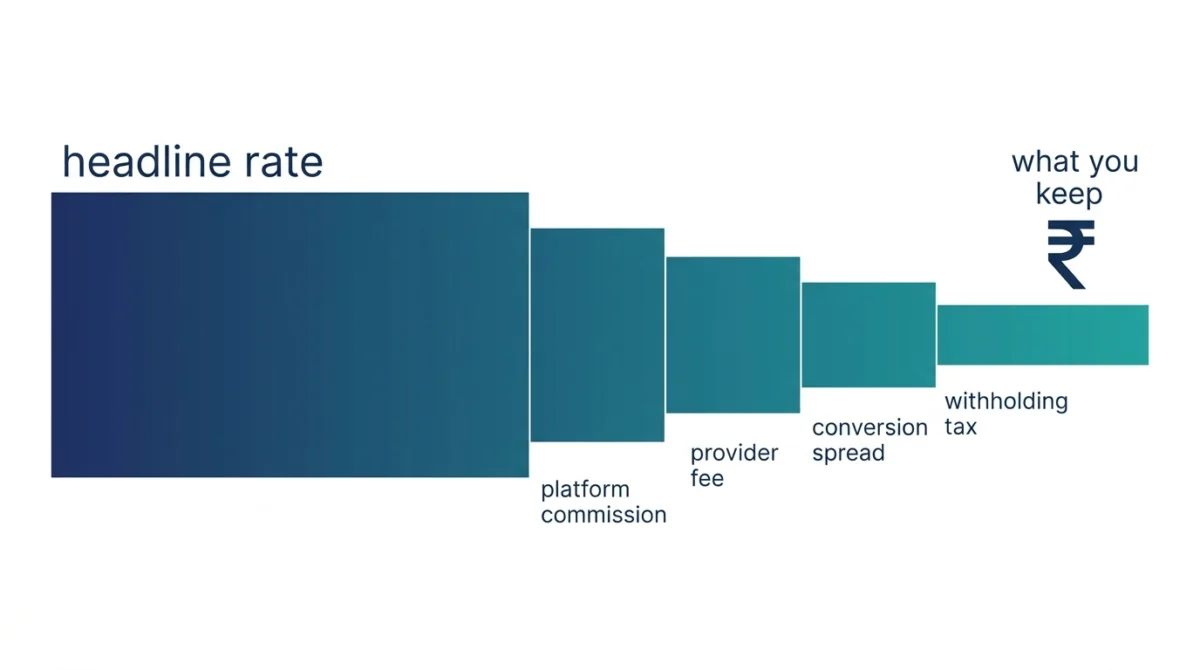
The practical implication is the same as everywhere else, only more urgent: competing on being cheaper than the global average was already a thin strategy, and it is the exact position AI has undercut. The 0.25% tax rate available to PSEB-registered exporters and the shift toward direct clients both help — but neither fixes a service a client can now generate themselves.
Is Freelancing Dead for Beginners in 2026?
For beginners specifically, this is where the question stings most — and the answer is still no, freelancing is not dead, but not the way the 2019 guides describe it. The path that worked then (pick a broad skill, open a Fiverr gig, compete on price and turnaround until reviews accumulate) is the exact path the market has stopped rewarding. That bottom rung has been sawn off.
So: is freelancing dead as a starting point? The old version of it is. What replaces it is narrower and slower to start: one specific problem for one specific type of client, a visible track record you own rather than rent, and a clear account of where AI fits in your process. It is less comfortable than the old route. It is also considerably harder for a subscription to replace.
Frequently asked questions
Is freelancing dead in 2026?
No. Overall demand is still growing, but it has split. Low-skill, high-volume work is being absorbed by AI tools, while specialised work is growing quickly — AI-related freelance hiring on Upwork rose 109% year over year in its 2026 report.
Why did my Fiverr or Upwork orders drop?
Most likely because your service competes with what clients can now generate themselves. Both platforms have seen falling app downloads since 2024 as buyers handle routine writing, design, and translation tasks directly with AI tools.
Which freelance skills are safest from AI?
Work built on judgement rather than production: strategy, creative direction, client relationships, complex problem-solving, and deep industry expertise. Purely executional services are the most exposed, regardless of how skilled the execution is.
Should I tell clients I use AI?
Specificity beats both silence and vague disclosure. Clients respond better to a precise account of which tools do which tasks and what you verify manually than to either a blanket “I use AI” or a claim of no AI use at all.
Is it worth leaving freelance platforms entirely?
Not abruptly. Direct clients pay noticeably more with no platform commission, but building a dependable direct pipeline typically takes six to twelve months. Build it alongside platform work rather than instead of it.